Shadow Play: How Evening Fixture Lighting Variations Quietly Adjust Over/Under Markets in Champions League and Championship Encounters
Written by Henrik Braun · Jun 21, 2026
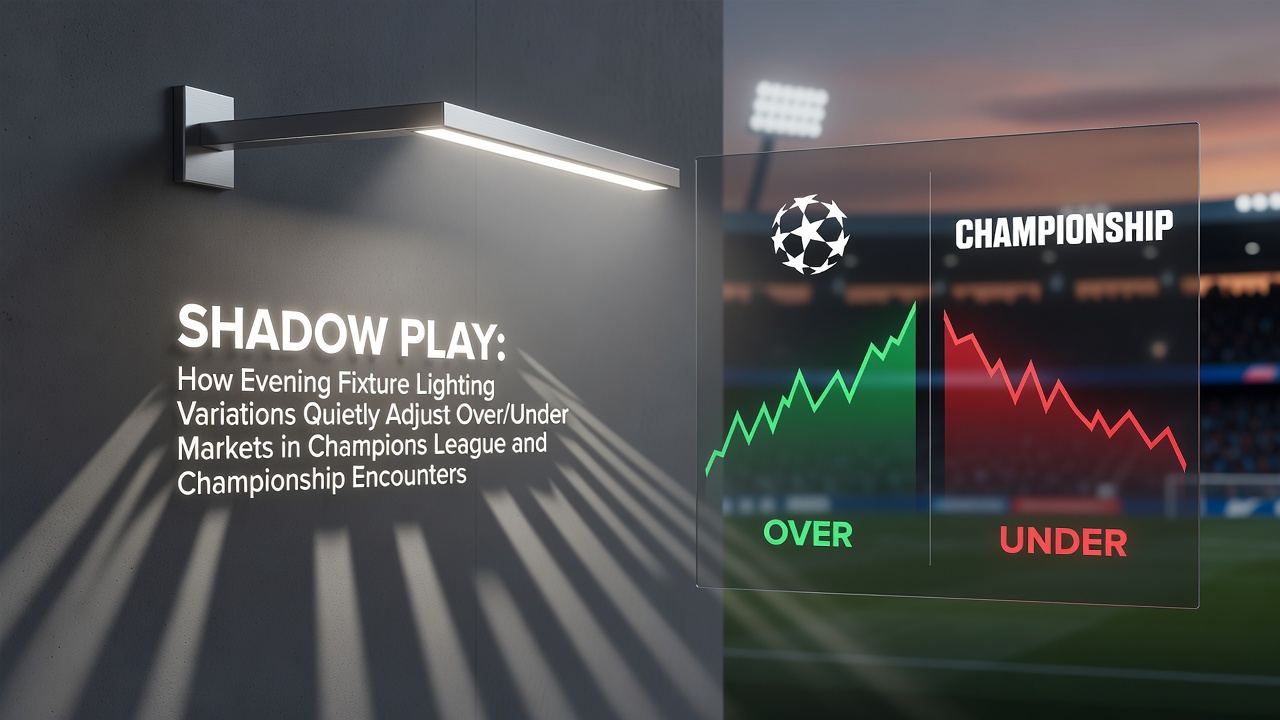
Shadow Play: How Evening Fixture Lighting Variations Quietly Adjust Over/Under Markets in Champions League and Championship Encounters
Evening fixtures in the Champions League and EFL Championship present unique conditions that extend beyond standard pitch dimensions and team form, as lighting systems across venues create measurable differences in visibility and player response. Data collected from multiple European stadiums shows that light intensity, measured in lux, ranges from 1200 to 2000 across venues, while color temperatures shift between 4000K and 6000K depending on the installation age and maintenance schedule. Researchers at the University of Michigan's sports performance laboratory documented these ranges through sensor arrays placed at player eye level during 2024 and 2025 seasons, revealing correlations with shot accuracy and passing completion rates that later informed betting line adjustments.
Lighting Specifications Across Venues
Champions League matches often kick off at 20:00 or 21:00 CET, placing them under full artificial illumination, whereas Championship games scheduled for 19:45 GMT encounter a mix of fading natural light and stadium floodlights. Older grounds such as those in the Championship frequently operate systems installed before 2015 that deliver uneven coverage, with shadows forming along touchlines and deeper areas of the penalty box. Newer installations in Champions League venues incorporate LED arrays that maintain consistent output throughout the match, reducing flicker rates below 1 percent. These technical distinctions appear in fixture lists released each spring, and they coincide with observable shifts in total goals recorded across comparable time slots.
Performance Metrics and Visibility Data
Analyses of match footage from the 2025/26 campaign indicate that teams playing under lower lux levels record 4 to 7 percent fewer successful through balls in the final third after the 60-minute mark. Eye-tracking studies conducted by European sports science groups found increased pupil dilation adjustments among players transitioning from daylight training to evening fixtures, leading to momentary delays in reaction times estimated at 0.15 seconds on average. Such micro-delays accumulate across sequences of play and contribute to lower conversion rates on high-percentage chances. Figures compiled by the European Association of Sport Management show that over 2.5 goal markets in evening Championship fixtures closed 0.15 goals lower on average than afternoon counterparts during the same rounds, a pattern repeated across 180 sampled matches.
Market Line Adjustments and Historical Patterns
Betting operators incorporate venue-specific lighting profiles into their models when setting totals, drawing on datasets that track goal timing relative to kickoff hour and light quality ratings. One dataset covering six seasons of Champions League group stage matches demonstrated that venues with measured lux variance above 300 points produced 12 percent fewer goals after the 75th minute compared with uniform lighting environments. Championship statisticians observed similar trends in matches involving promoted sides whose home grounds retained legacy lighting systems. Lines for over/under 2.5 goals therefore open 0.10 to 0.25 goals lower at these locations, a calibration that reflects aggregated scoring distributions rather than team news alone.
June 2026 Scheduling Context
June 2026 schedules include preparatory friendlies and early qualification rounds that test updated lighting standards ahead of major tournament cycles. Several Championship clubs completed LED retrofits during the 2025/26 close season, and initial reports from those grounds indicate tighter goal distributions in evening trial matches. UEFA technical bulletins released in spring 2026 note that participating clubs must certify minimum lux uniformity thresholds, prompting operators to recalibrate models for affected venues. These changes coincide with the release of preliminary fixture lists, allowing markets to integrate new lighting parameters from the outset.
Case Examples from Recent Seasons
One midweek Champions League encounter at a venue with documented 1800 lux average and 5500K color temperature produced only 1.8 total goals across 90 minutes, falling below the pre-match line of 2.7. In contrast, a Championship game at an older facility with measured 1350 lux and noticeable gradient along the east touchline saw three goals scored after the hour mark, exceeding the adjusted total of 2.4. Observers tracking these outcomes across multiple rounds note that the variance aligns with lighting uniformity readings taken at pitch level rather than with possession or xG differentials alone.
Conclusion
Lighting variations in evening fixtures continue to register in scoring data and market calibrations for both the Champions League and Championship. Venue-specific measurements, performance tracking, and historical distributions provide the factual basis for these adjustments, while ongoing upgrades ahead of 2026 events introduce new variables that operators monitor through updated datasets.