How Referee Appointment Rotations Reveal Patterns in European League Disciplinary Markets
Written by Zara Schröder · Aug 4, 2026
How Referee Appointment Rotations Reveal Patterns in European League Disciplinary Markets
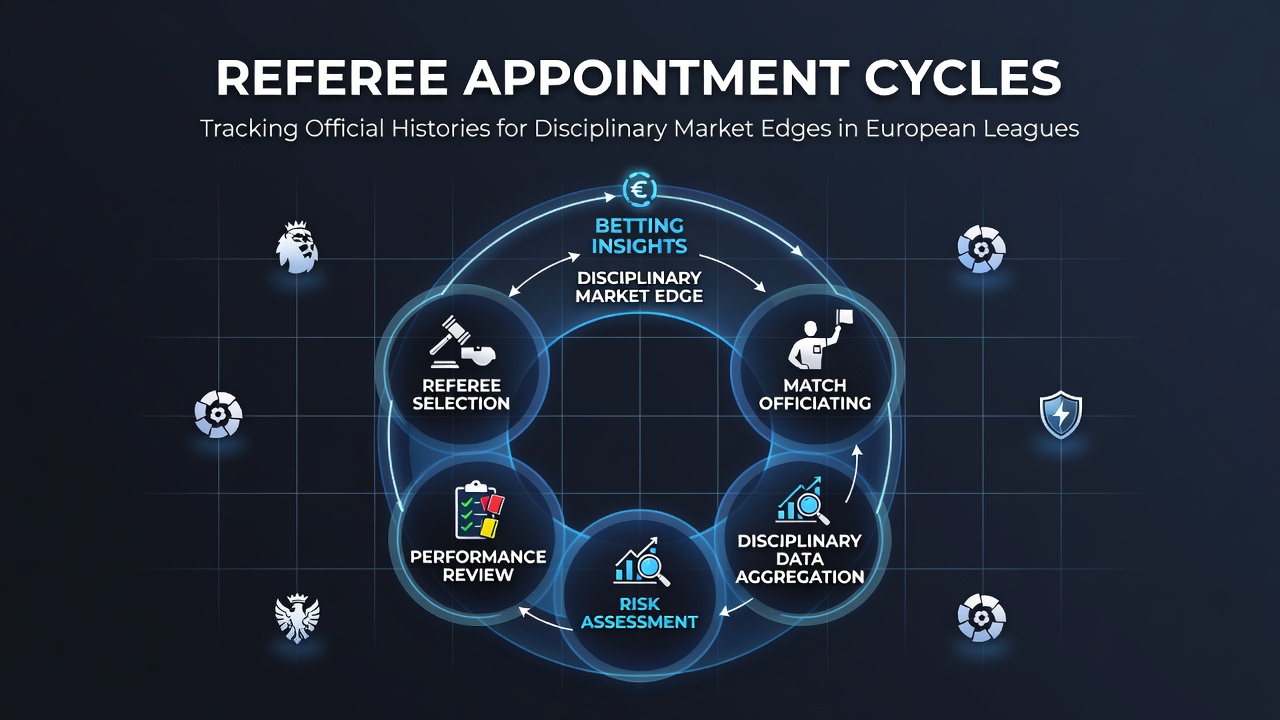
Referee appointment cycles in European football operate on structured rotation systems that assign officials to matches across the Premier League, La Liga, Serie A, Bundesliga, and Ligue 1, and data from these cycles shows measurable correlations with card and foul statistics, according to records maintained by national federations. Appointments typically follow a four-to-six-week pattern where top-tier referees receive assignments in high-profile fixtures while others handle mid-table contests, creating predictable distributions of disciplinary outcomes when historical tendencies are tracked over multiple seasons.
National associations publish weekly referee lists that detail both the primary official and video assistant referee teams, and observers have noted that certain referees maintain consistent card averages across home and away games while others shift based on venue and team styles. In August 2026, early-season appointments across the five major leagues revealed standard pre-rotation patterns, with newly promoted sides often paired with officials who have handled their previous campaigns, allowing analysts to cross-reference prior disciplinary data for those specific matchups.
League-Specific Rotation Frameworks
Each league maintains distinct appointment protocols that influence how officials accumulate experience in particular contexts. The Premier League uses a centralized selection committee that factors in referee fitness reports and previous performance metrics, whereas Serie A incorporates regional rotation requirements that limit how frequently officials from the same geographic area handle matches involving local clubs. Data indicates that Bundesliga appointments emphasize continuity for referees who demonstrate low variance in foul calls per game, which produces tighter clustering of yellow card totals compared to La Liga, where broader rotation spreads officials across more varied team profiles.
Those who have examined multi-year appointment logs find that referees with more than 25 prior matches in a given league tend to show stable over-under card rates, while newer appointments introduce higher variability during the first eight to ten games of a season. This pattern holds across both domestic competitions and European club tournaments, where UEFA maintains a separate but overlapping appointment calendar that intersects with national schedules during autumn and spring windows.
Historical Data Tracking Methods
Analysts compile referee histories by logging every card issued, along with contextual variables such as match importance, team disciplinary records, and time of season. These datasets reveal that certain officials average 4.8 yellow cards per game when assigned to teams ranked in the bottom six of their league, compared with 3.9 cards when handling top-six encounters, and the difference persists across multiple appointment cycles. Such figures come from aggregated match reports rather than single-season snapshots, allowing identification of referees whose tendencies remain consistent regardless of fixture difficulty.

Cross-league comparisons further show that officials who rotate between domestic and continental fixtures often carry slight shifts in their foul threshold, particularly when moving from high-tempo leagues to more physical ones. A study released by the University of Amsterdam's sports analytics department documented these adjustments over five seasons and linked them to appointment frequency rather than individual referee preference. Meanwhile, reports from the Australian Institute of Sport have examined parallel patterns in other professional codes, providing methodological templates that European analysts adapt for football-specific variables.
Application to Disciplinary Markets
Market participants who monitor appointment announcements can align referee histories with expected card volumes for upcoming fixtures, and this alignment becomes more precise when cycles reach their midpoint and officials have accumulated enough recent matches to confirm or adjust prior averages. In Serie A, for example, appointments released on Thursdays allow several days to review an official's last six outings, including any trends in stoppage-time cards or reactions to specific tactical setups.
European federations release these schedules through official channels, and the information flows directly into statistical models that weight recent performance more heavily than older data. One consistent observation is that referees returning from injury or international duty often exhibit elevated card rates in their first two domestic assignments before settling back toward their established averages, a pattern confirmed across multiple seasons in both the Bundesliga and Ligue 1.
Conclusion
Referee appointment cycles provide a structured framework for examining disciplinary trends across Europe's leading leagues, and the combination of published schedules with historical performance records offers a factual basis for understanding how officials are distributed throughout the season. Continued collection of match-by-match data will maintain the accuracy of these patterns as rotations evolve in response to league expansions and format changes.